Anonymous submission Under review Code & Dataset 16 robust methods 6 shift channels Humanoid & VLA

RobustRLlib: A Unified Library and Benchmark for
Robust Reinforcement Learning Algorithms

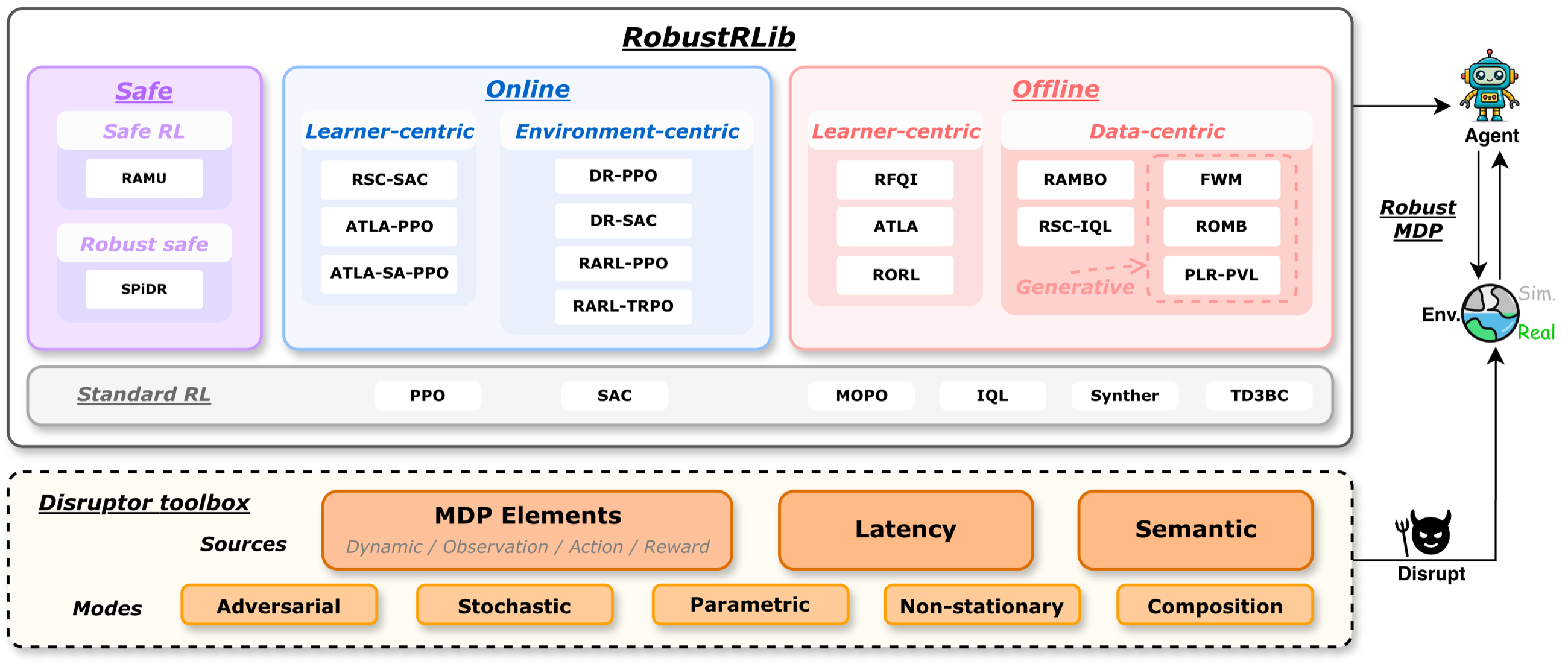
Overview of RobustRLlib: an algorithm-centric robust RL library, a composable disruptor toolbox, and a shared evaluation platform.
Overview of RobustRLlib. Robust RL methods are registered together with the mechanism they add, the shift they claim to address and the base learner that realises them; a shared disruptor toolbox then instantiates every shift channel independently of the learner, and one evaluation platform measures both general robustness and mechanism-specific specialisation — from standard control to humanoid and VLA tasks.

ABSTRACT

Robust reinforcement learning (RL) is critical for reliable real-world deployment, where policies may fail under diverse shifts and disruptions. Existing robust RL algorithms offer a rich set of mechanisms and principles, yet two major barriers limit their broader potential: limited algorithm reusability and an unclear empirical capability boundary. We introduce RobustRLlib, an algorithm-centric library and benchmark that addresses both challenges. It integrates 16 representative robust online, offline, and safe RL methods under a unified interface for substantially improved reusability, together with an enhanced evaluation platform spanning diverse real-world shifts and advanced humanoid and vision–language–action tasks. Systematic evaluation provides an up-to-date capability map of current robust RL algorithms, revealing where they remain effective and where substantial robustness gaps persist. As an open-source, user-friendly platform, RobustRLlib offers a reproducible and extensible codebase for applying existing methods to new problems and developing new robust RL algorithms.

01 Two barriers, one platform

Robust RL has produced many mechanisms, but each is developed, trained and reported inside its own setting. RobustRLlib fixes the unit of comparison at the algorithm rather than adding another task suite.

Barrier 1

Algorithms are not reusable

Robust RL methods are fragmented across separate implementations and training pipelines. There is no single interface through which a practitioner can try a broad collection of robust methods on a new application, and no shared place to build the next one.

Barrier 2

The capability boundary is unclear

Methods are reported under different tasks, budgets and shift definitions — sometimes under the very perturbation their mechanism targets. A reported gain therefore cannot be separated from the setup that produced it, and it is unclear whether a method withstands the shift it claims to address.

What RobustRLlib contributes

Contribution 1

A robust RL algorithm library

Sixteen representative robust online, offline and safe RL methods in one reusable codebase, organised by learning mechanism, intended shift target and base algorithm.

Contribution 2

An enhanced evaluation platform

An extensible disruptor toolbox covering MDP-element shifts plus control-loop latency and task semantics, with stochastic, adversarial, parametric and non-stationary modes that compose — and the same interface carried onto Isaac Lab and VLA tasks.

Contribution 3

An up-to-date capability map

A unified, shift-isolated evaluation of the whole library on four task families and four severity quartiles, connecting each mechanism to its measured strengths and failure modes.

16robust methodsonline · offline · safe
22algorithms total6 standard references
6shift channels+ composed levels L1–L3
14task familiescontrol + robotics
5training seeds20 paired episodes / condition

02 The robust RL algorithm library

RobustRLlib is organised around algorithm attribution: every method records how it changes learning, which shift it claims to address, and which base algorithm realises it. Three tracks — offline, online and safe — split further by the route robustness enters through.

ROUTELearner-centric
Changes how experience is interpreted or optimised: worst-case Bellman backups, local policy/value smoothing, observation adversaries, causal counterfactual replay.
  • RFQI · RORL · ATLA · ATLA-SA · RSC
ROUTEData-centric
Reshapes the training distribution available to the base learner through augmentation, counterfactual transitions or generative models of trajectories.
  • RSC-IQL · RAMBO · ROMB · FWM · PLR-PVL
ROUTEEnvironment-centric
Partially obtains access to a shifted environment and constructs training rollouts under disturbances, e.g. adversarial forces or randomised physics.
  • RARL · DR (domain randomisation)
Regime Family Method Shifted data Generative model Extra network Claimed robustness Base algorithm
Robust Offline — learns from a fixed dataset without environment interaction
Robust OfflineLearner-centricRFQI—DynamicFQI
RORL—ObservationSAC
ATLA—✓ObservationIQL
Data-centricRSC-IQL—✓SemanticsIQL
RAMBO—✓DynamicSAC
ROMB—✓✓DynamicIQL
FWM—✓✓DynamicIQL
PLR-PVL—✓✓DynamicIQL
Robust Online — learns through continued environment interaction
Robust OnlineLearner-centricATLA✓—✓ObservationPPO
ATLA-SA✓—✓ObservationPPO
RSC✓—✓SemanticsSAC
Environment-centricRARL✓—✓DynamicPPO / TRPO
DR✓—DynamicSAC
Robust Safe — adds cost constraints, including robust-safe methods implemented in the online setting
Robust SafeRobust SafeRAMU✓—DynamicPPO
SPiDR✓—✓DynamicPPO

Structural comparison of the robust methods in the library. Shifted data indicates whether the algorithm can obtain access to a shifted environment; generative model marks methods that explicitly learn a distribution over transitions or future trajectories; extra network marks methods that train an additional adversary or transition model; claimed robustness records the intended shift target. Standard references (PPO, TRPO, SAC, IQL, TD3+BC, MOPO, SynthER) are excluded from the table.

How a method is compared to its own backbone

Preserving native training configurations while standardising evaluation gives two complementary levels of comparison. A unified post-training benchmark evaluates all eligible algorithms on a common task and perturbation grid to measure robustness breadth; an algorithm-specific benchmark evaluates each method against the baselines targeted by its robustness mechanism to reveal specialisation.

BenchmarkRobust algorithmsMDP shiftsLatencySemanticCompoundTask expansion
RLlib00/4✗✗✗✓
RRLS41/4✗✗◐◐
ODRL01/4✗✗✗✗
Robust-Gymnasium44/4✗✓✓✓
RWRL Suite03/4✓✗✓✗
RoAd-RL01/4✗✗✗✓
RobustRLlib (ours)164/4✓✓✓✓

Comparison with related RL libraries and robustness benchmarks. Robust algorithms counts robust or safe methods evaluated by each benchmark, excluding standard reference learners. A checkmark denotes explicit, evaluated support; ◐ denotes partial or scope-limited support; ✗ indicates the capability is absent or not demonstrated in the cited release. MDP counts, out of four, the MDP components on which shift is evaluated: observations, actions, transitions and reward/cost. Compound requires multiple shift sources to be active jointly. Task expansion indicates an extensible interface for carrying the benchmark to additional task backends.

03 The disruptor toolbox

A deployment shift rarely changes an MDP wholesale; it enters at an identifiable point of the interaction loop — the sensor, the actuator, the physics, the timing, the reward, or the task itself. RobustRLlib describes a shifted environment by one parameter vector

θ = ( θo, θa, θp, θτ, θr, θc, θz )

whose components intervene on observation, actuation, physical dynamics, timing, reward, cost and task semantics, while θ = θ0 recovers the nominal problem exactly. Because each shift has its own component, the toolbox can tell failure modes apart instead of folding them into a single robustness score: a method that tolerates θo and breaks under θp is reported as exactly that.

ot ~ Oθᵒ,θᶻ(· | st−δₒ)     ãt ~ Aθᵃ(· | st, at−δₐ)     st+1 ~ P(κ)θᵖ,θᶻ(· | st, ãt)
rt ~ Rθʳ,θᶻ(· | st, ãt, st+1)     ct ~ Cθᶜ,θᶻ(· | st, ãt, st+1)

Six shift sources

θᵒ Observation

Corrupts what the policy sees — additive noise, feature-relative noise, sensor bias, adversarial perturbations.

gauss · uniform · relative · bias · adversarial ($\ell_\infty$)

θᵃ Action

Corrupts what the policy does, including state- or goal-directed adversaries that occupy the same channel as additive actuator noise.

gauss · uniform · oppose · rotate · oppose_goal

θᵖ Physical dynamics

Moves the reachable set rather than reweighting it: gravity and wind, mass and inertia, morphology, friction, actuator gear and power, external pushes.

scale · set · uniform · gauss · loguniform · push

θᵗ Latency

Governs when information and commands arrive: observation delay δo (fractional, interpolated), action delay δa, and control period κ.

buffer · substep · interp · fixed

θʳ,θᶜ Reward / cost

Noisy or biased supervision on the learning signal, kept separate from the underlying transition; reward and cost channels are distinct.

gauss · uniform · shift · delay

θᶻ Task semantics

Changes task-relevant scenes or structure — appearance, lighting, hue, blur, distractors, or a relocated goal — often acting through observation, transition and reward at once.

hue · tint · swap · translate

Five modes, and every specification is composable

Stochastic

Samples signal errors or model parameters from a specified distribution, with the resampling rule declared (per step, per reset, per episode).

Adversarial

Computes bounded perturbations from the current state to counter the policy, at a stated ε radius.

Parametric

Applies a specified assignment, scale, offset or translation at a given severity.

Non-stationary

Varies a mode's severity over time via a schedule, or triggers intermittent disturbances.

Composition

Stacks compatible shifts into reproducible multi-shift conditions, evaluated as ordered tuples.

Graded sim-to-real scenarios

Single-axis sweeps isolate a mechanism, but deployments combine uncertainty sources. Three levels therefore nest progressively richer conditions — L1 ⊂ L2 ⊂ L3 as sets of active components — so a method can be located by the first level at which it breaks.

ScenarioActive componentsSupported disruptors
L1 · Physical mismatchθpGravity and wind; body/object mass and inertia; link morphology and geometry; contact friction
L2 · Control mismatch+ θa, θo, θzActuator gear and engine power; joint damping and dry friction; action noise; feature-relative observation noise; camera, lighting and appearance variation
L3 · Deployment-level gap+ θτ, g(t;φ)Fixed or randomised action delay; interpolated observation delay; variable control period; episode-level sensor bias; scheduled parameter drift; latent process noise; intermittent external pushes
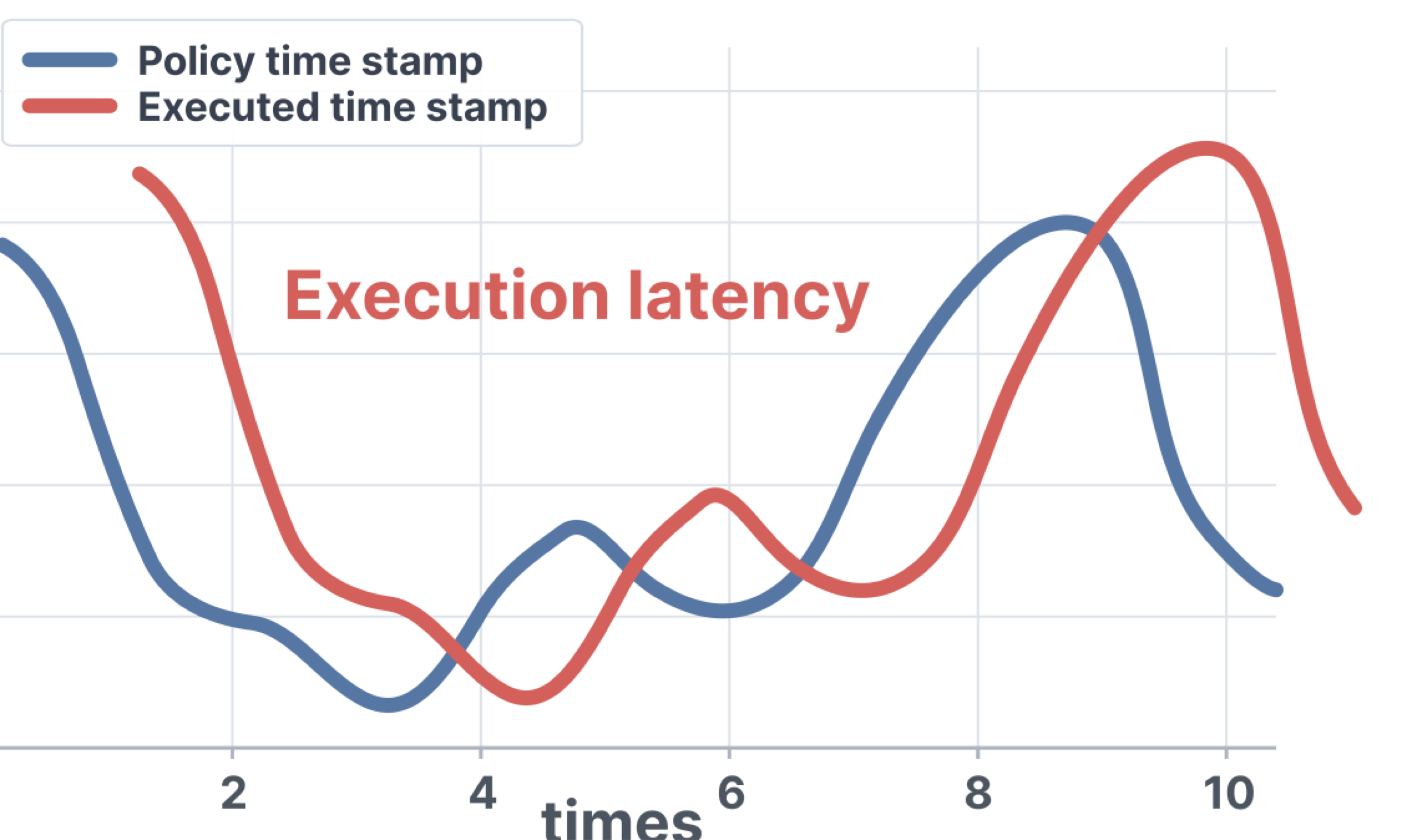
Latency shift: observation delay, action delay, and variable control period.
Latency shift. Delayed sensing, delayed execution and variable control rates are treated as first-class deployment channels rather than simulator artefacts.
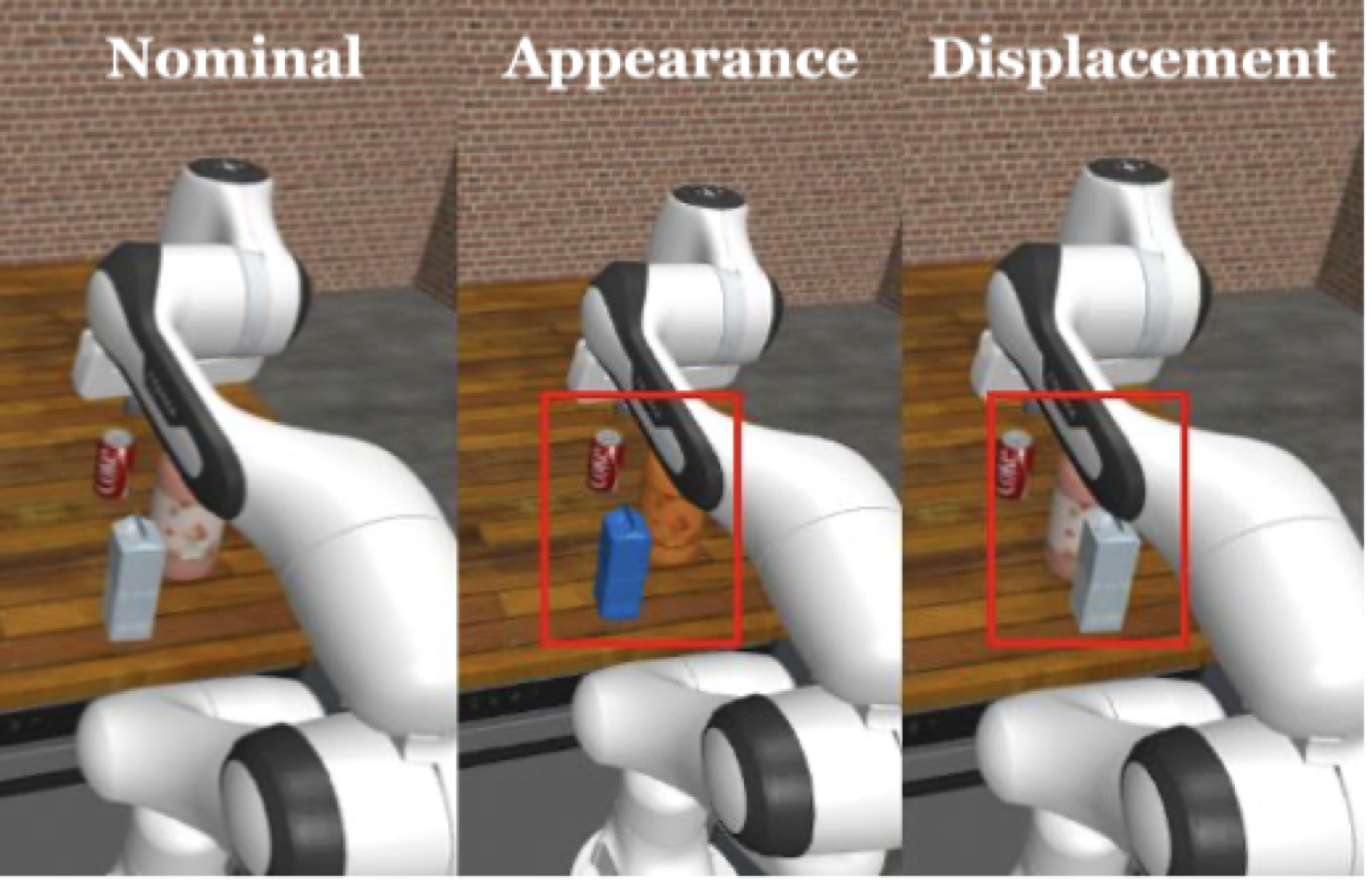
Semantic shift acting through observation, transition and reward.
Semantic shift. Appearance or task-semantic changes that a nominal MDP component cannot represent cleanly; with the VLA study they become the dominant failure channel.

04 Evaluation protocol

Every method starts from the same nominal task specification, uses its native training procedure and prescribed budget, and is then frozen and evaluated on the same shift grid. Five training seeds and twenty paired evaluation episodes per condition; scores are aggregated across severities within an axis and then across seeds, so denser axes receive no extra weight.

Metric

Unclipped normalised score

S(R̄) = 100 (R̄ − Rmin) / (Rmax − Rmin), with one fixed task-level reference pair shared by every method, dataset quality and condition.

Severity

Quartiles Q1–Q4

Severity is reported in quartiles of each ladder's own length, so comparison is within a channel's ladder rather than on a scale shared across axes.

Uncertainty

Paired per-seed differences

Aggregate distributions across training seeds rather than treating evaluation episodes as independent runs; paired per-seed differences are used whenever a mechanism is compared with its backbone.

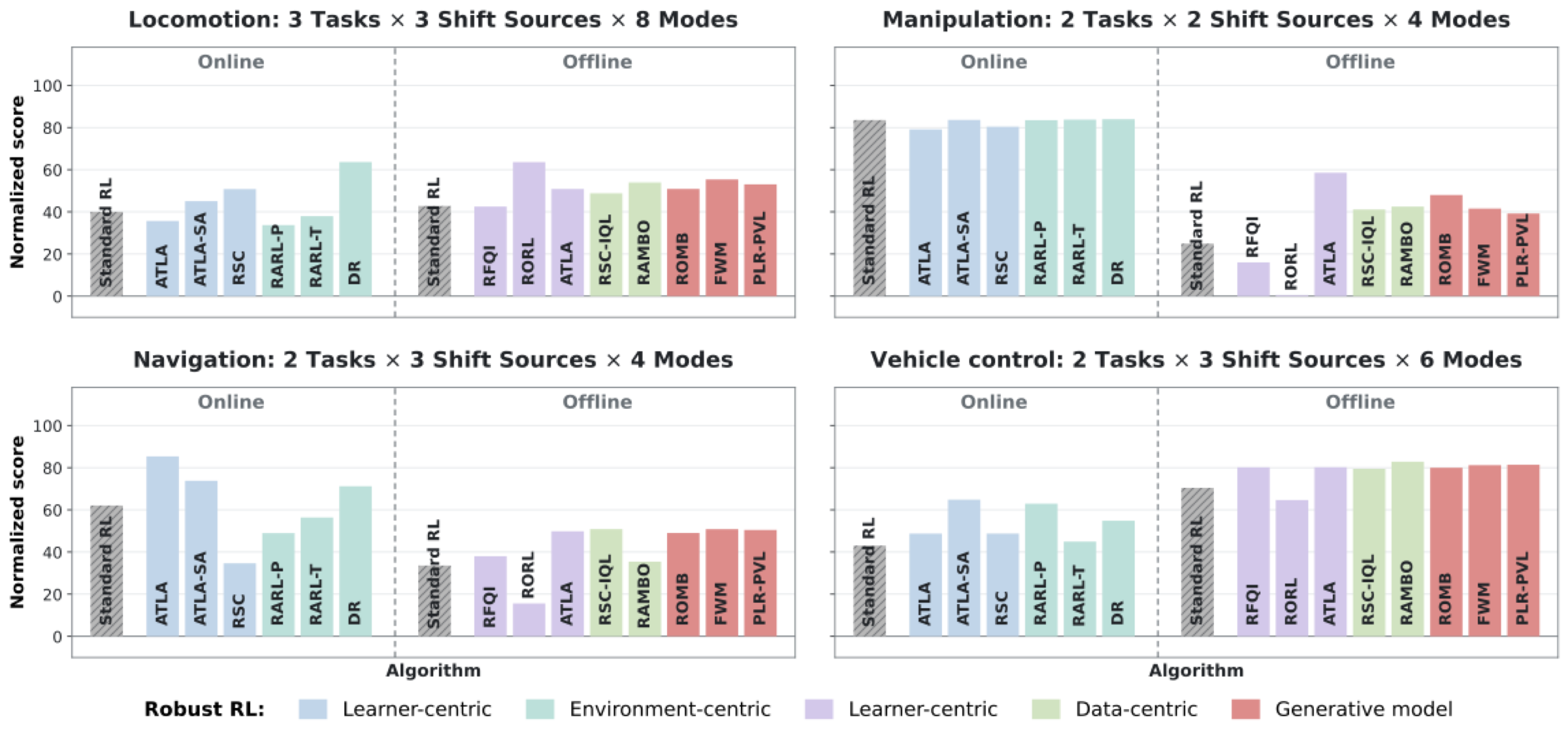
Library-wide robustness under controlled distribution shift

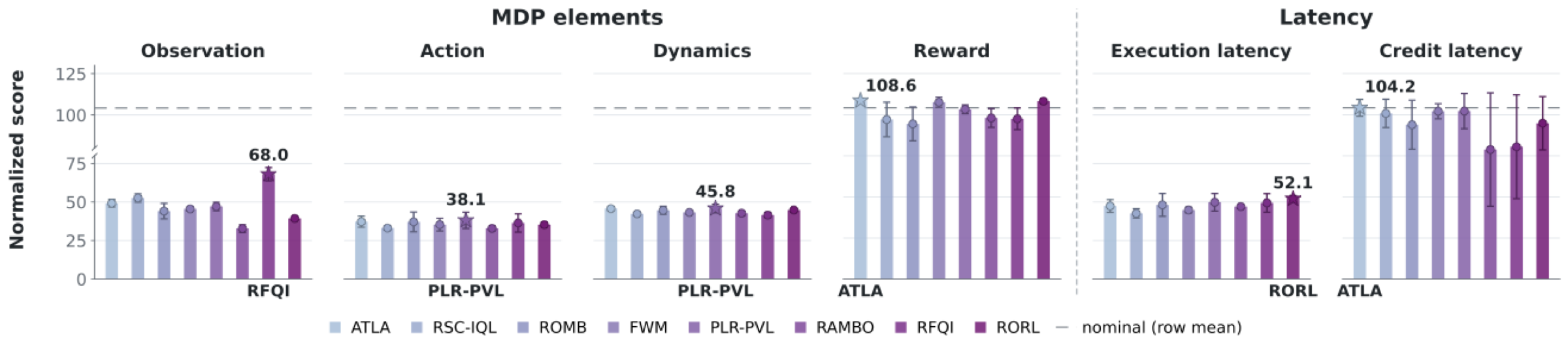
Every robust method as a separate bar, keyed by mechanism family and online/offline regime.
The full library under controlled distribution shift. Every coloured bar is one of the fourteen robust methods, keyed by mechanism family and online/offline regime. Scores average severities within a shift source, sources within a task, and then tasks with equal weight.
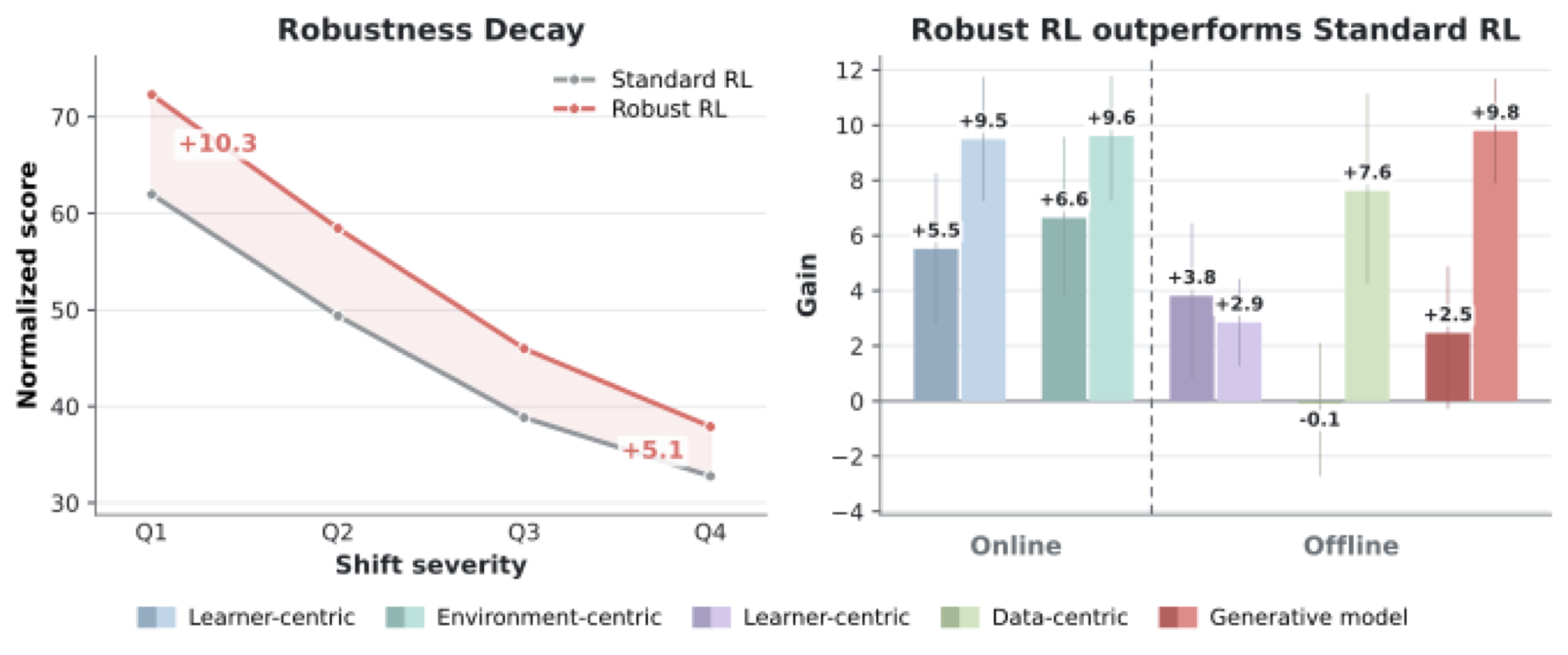
Robustness across severity quartiles and mechanism family gains.
Robustness across severity and mechanism families. Left: pooled Standard and Robust scores across severity quartiles Q1–Q4. Right: each family's gain over each member's own base algorithm (dark) and over the pooled Standard RL mean (light).

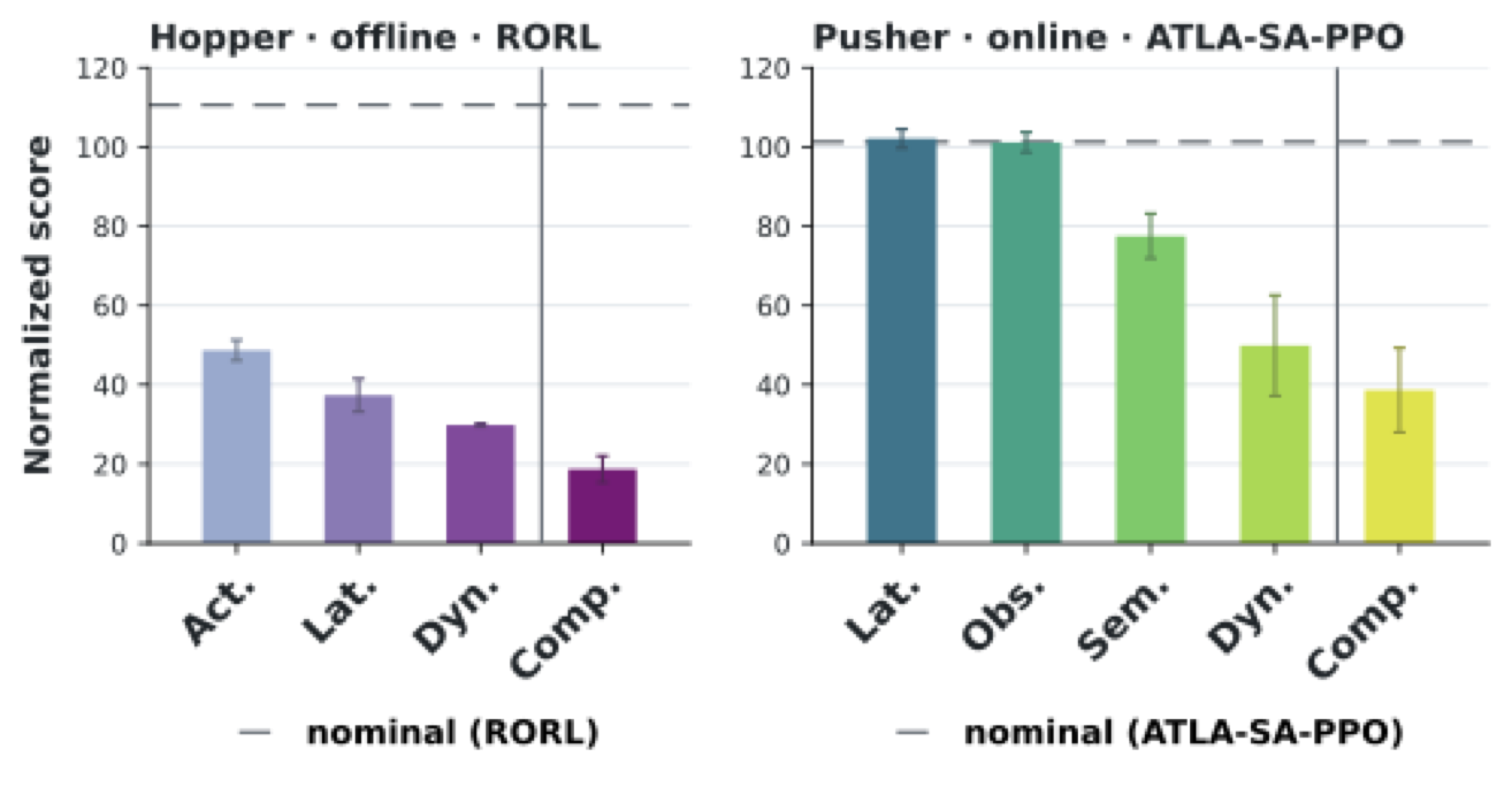
Isolated and compound deployment shifts

Method-specific robustness is measured through isolated channel sweeps across multiple perturbation modes, and through reference-derived compound shifts: Hopper adapts the coupled physical, actuation, force and delay factors of OmniH2O, while Pusher adapts the dynamics, observation and control-rate factors of Peng et al., with goal displacement labelled separately.

Isolated shift evaluation for online methods.
Isolated shift evaluation — online. Causal binding is online only and runs on the goal-conditioned causal door task.
Isolated shift evaluation for offline methods.
Isolated shift evaluation — offline. The same channel grid, evaluated on methods that learn from fixed data.
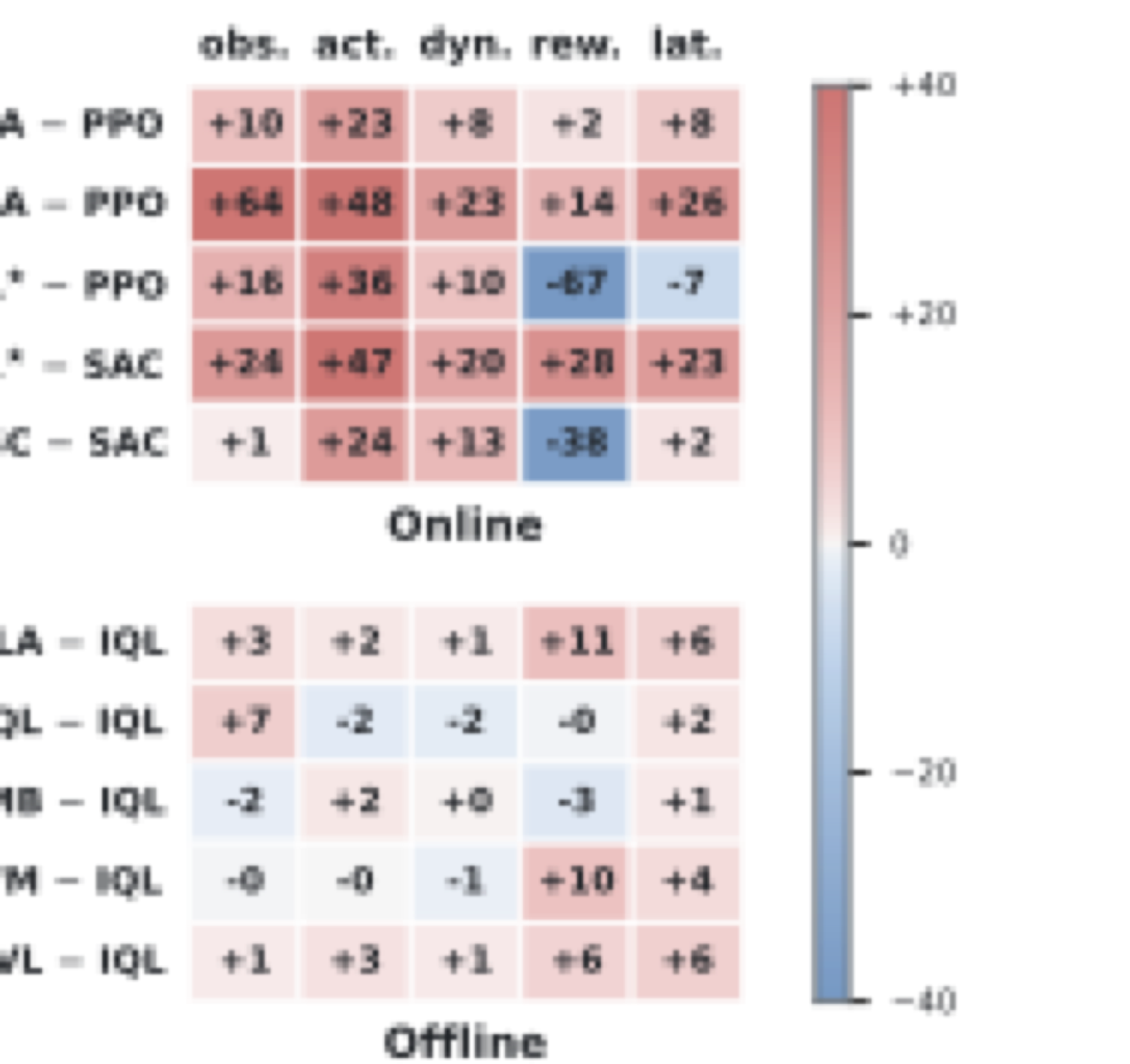
Paired gain over base algorithm across five shift sources and twenty conditions.
Paired gain over the base algorithm. Evaluated under five shift sources and twenty conditions.
Compound shifts separated by shift source.
Compound shifts, separated by shift source. Each panel shows the strongest online and offline robust method under shift sources in isolation and in composition.

Extension to advanced robotic tasks

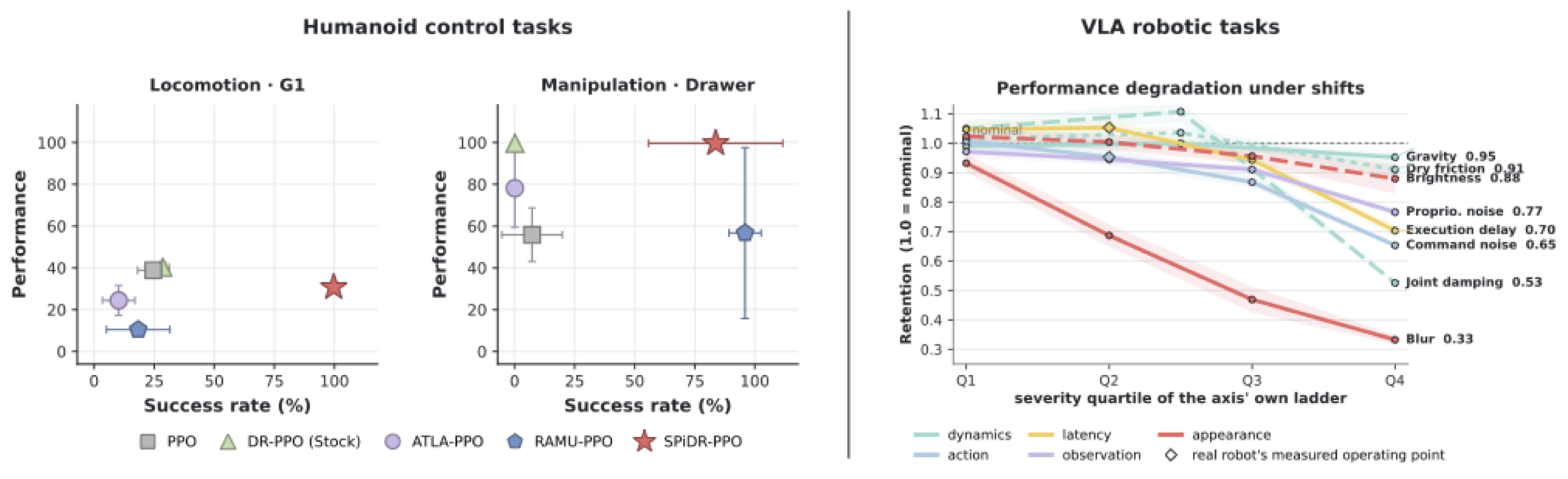
The same disruption interface is attached through task-specific adapters to a high-dimensional humanoid, a contact-rich manipulator in Isaac Lab, and a vision–language–action policy fine-tuned on bimanual demonstrations. On G1 the two highest-scoring policies survive about a quarter of delayed episodes; on the Franka drawer, DR-PPO matches SPiDR's success rate while no episode stays inside the joint-limit cost budget, against 84% for SPiDR. Only SPiDR-PPO keeps both metrics high on both tasks — higher performance alone is not evidence that a method is ready for sim-to-real deployment.

Humanoid control and VLA task results.
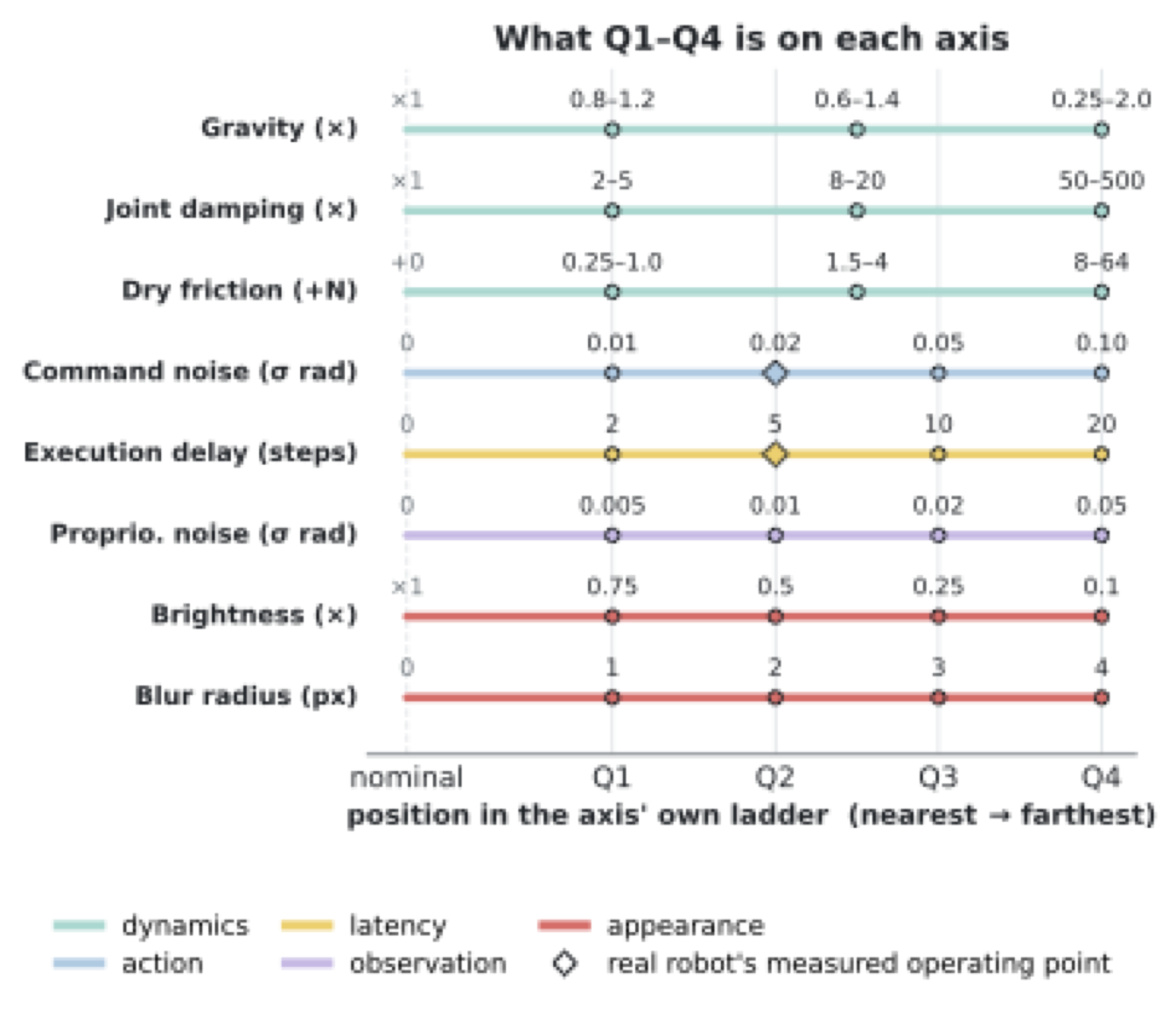
Humanoid control and VLA task results. Left: one point per method — task performance against the safety success rate on G1 survival under action delay, and drawer episodes that stay inside the joint-limit cost budget. Right: what a VLA policy retains as each shift axis is pushed along its own severity ladder, with the diamond marking each axis' operating point measured on the real platform.
VLA retention along each shift axis' severity ladder.
Retention along each VLA shift ladder. At the largest measured severity the policy still retains 0.95 under gravity but only 0.33 under image blur.
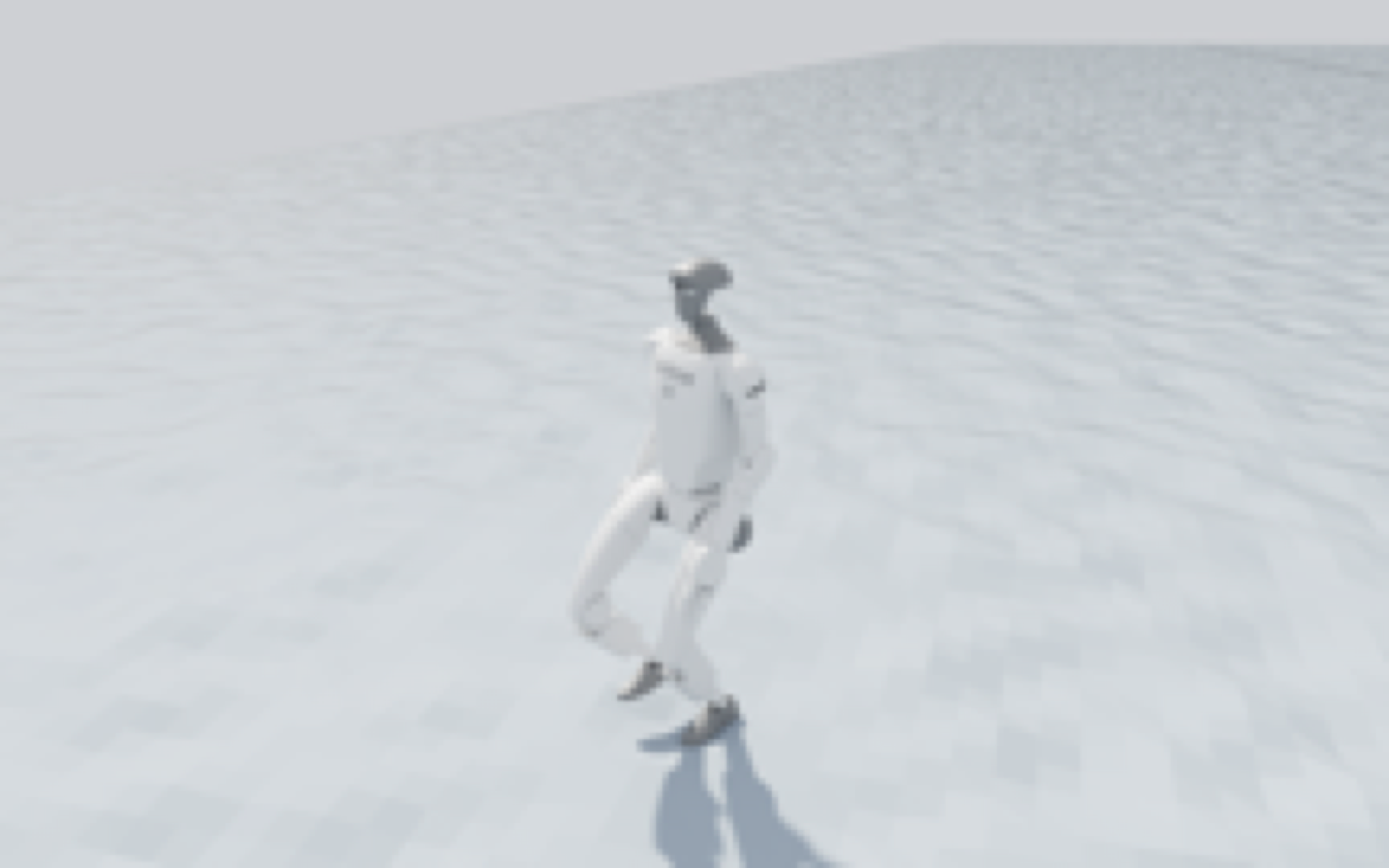
Unitree G1 humanoid locomotion task.
Unitree G1 locomotion. A 123-D state and 37-D action interface at 50 Hz, evaluated for return and survival under action delay.

05 What the capability map shows

Under one protocol, robust methods as a group outperform standard references — but the picture is not uniform, and the shift a method claims is a poor predictor of the shift it actually defends.

  1. Robust RL helps at every severity, but everyone degrades as shifts intensify. Robust methods achieve a higher pooled normalised score than standard RL in all four severity quartiles, but their advantage narrows from +10.3 points in Q1 to +5.1 in Q4 while both groups' scores decline. Robustness raises the whole degradation curve without moving the point at which it collapses.
  2. Dynamics-aware mechanisms are stronger under dynamics shifts. Environment-centric online methods and generative offline methods show some of the largest gains on physical shifts, consistent with their exposure to varied dynamics or explicit modelling of trajectories. Relative to their own base algorithms, online robustness mechanisms yield larger incremental gains, whereas offline methods benefit more from the robustness of their base learners.
  3. Claimed channels do not fully predict empirical strengths. On isolated sweeps, DR-SAC leads both dynamics and execution latency, while ATLA-SA-PPO leads observation and action; the offline leaders vary across channels. The measured ranking is also conditional on the task, the mode and the severity used to instantiate each shift.
  4. Dynamics is the common core shift; the second most damaging shift is task-specific. Dynamics alone halves the score on manipulation and is the worst single source in both tested tasks. Locomotion then loses about three quarters of its score to latency — a delayed action on a balancing gait is a fall, not a slower trajectory — while the same delay leaves manipulation essentially untouched, where instead semantic shift costs a quarter. Compound conditions are worse than any of their parts, dropping the two most robust algorithms below half of nominal on manipulation and below a fifth on locomotion.
  5. Robustness transfers return but not constraint satisfaction. Constraint satisfaction is what makes a transfer deployable, and return alone does not imply it: on the Franka drawer, DR-PPO matches SPiDR's 99.6% success with 0% of episodes inside the joint-limit cost budget against SPiDR's 84%.
  6. Shift channels differ sharply in how much they hurt a VLA policy. At the largest measured severity a fine-tuned π0.5 policy retains 0.95 under gravity but only 0.33 under image blur, with execution delay in between. Blur at its largest severity moves only 13% of the image yet drops the policy to a third of nominal, while brightness moves the same frames through the same channel at seven times that dose and costs almost nothing — semantic shift is a core factor for action chunks.

Taken together: evaluating dexterous, high-dimensional control needs more than one task or one configuration. Shift channel, mode, severity, dataset quality, task family and base learner each expose different capabilities and limits of current methods, which makes a shared library and a common protocol the precondition for knowing what a robust RL algorithm actually buys.

06 Tasks, datasets and interfaces

The library-wide grid spans locomotion, manipulation, navigation and vehicle control; two additional tasks supply the compound-profile and semantic-channel tests. Robust safe methods enter on the advanced robotics tasks, which also demonstrate the extensibility of the disruptor interface.

TaskObservationAction (rate)HorizonTask type
Standard control
Hopper-v511-D state3-D1,000Locomotion
Walker2d-v517-D state6-D1,000Locomotion
HalfCheetah-v517-D state6-D1,000Locomotion
AdroitHandDoor-v139-D state28-D200Manipulation
FetchReach-v413-D proprioception + relative goal4-D50Manipulation
Pusher-v523-D state7-D100Manipulation
DoorCausalState—300Manipulation
PointMaze_UMaze-v36-D state + desired goal2-D300Navigation
PointMaze_Open-v36-D state + desired goal2-D300Navigation
CarRacing-v396 × 96 × 3 pixels3-D1,000Driving
LunarLanderContinuous-v38-D state2-D1,000Driving
Advanced robotics
Unitree Go248-D state12-D (50 Hz)1,000Locomotion
Unitree G1123-D state37-D (50 Hz)1,000Locomotion
Franka Drawer31-D state8-D (60 Hz)480Manipulation
insert-mouse-battery14-D joint state + three 180×320×3 camera streams14-D (60 Hz)DemoBimanual manipulation

Benchmark tasks. Observation and action specify the default policy interface; control rates are shown in parentheses where reported. Numeric horizons are the maximum number of environment steps per episode, while Demo follows the length of the recorded demonstration used for VLA evaluation.

Offline data and model-free references

Datasets

  • Hopper / Walker2d / HalfCheetah — Minari medium-v0, collected in Gymnasium v5 environments
  • AdroitHandDoor — D4RL/door/expert-v2, Minari port of D4RL trajectories
  • PointMaze_Open — D4RL/pointmaze/open-v2, Minari port of D4RL trajectories
  • LunarLanderContinuous — collected for this benchmark; deterministic SAC checkpoints trained for 1.5M steps, from which a medium corpus of 1,741 episodes is selected

Each dataset contains approximately one million transitions.

Interfaces and standard references

All tasks are exposed through standard Gymnasium single-agent and PettingZoo multi-agent interfaces and integrated with Stable-Baselines3, RLlib and TorchRL, so an external algorithm can be evaluated without rewriting its training loop. PPO and TRPO (on-policy) and SAC (off-policy) serve as the standard references throughout the experiments, alongside IQL, TD3+BC, MOPO and SynthER in the offline track.

07 Using the library

One interface for training, one for declaring a shift, and one for evaluation. The snippets below sketch the workflow; the released code, configuration files and evaluation records follow the same structure.

1

Register a method

Wrap an existing trainer so its mechanism, claimed shift and base algorithm are recorded as metadata and its update stays native.

2

Declare a shift

Build the environment by wrapping a standard task with an ordered list of ShiftSpec objects — one channel, one mode, a graded severity, an optional schedule and a seed.

3

Train and evaluate

Train under the nominal specification, freeze the policy, and evaluate it on the same grid for every method, with paired episode seeds and a predeclared checkpoint rule.

Declaring isolated shifts

# A deployment condition is one parameter vector, declared channel by channel.
from robustrllib import make_shifted_env, ShiftSpec

specs = [
    # theta^p — a randomised physical parameter, drawn once per reset
    ShiftSpec(channel="dynamics",  mode="loguniform", param="mass",    severity=[0.7, 1.4], resample="per_reset"),
    # theta^o — an adversarial observation perturbation at an L-infinity radius
    ShiftSpec(channel="observation", mode="adversarial",                severity=0.10,      resample="per_step"),
    # theta^tau — an interpolated observation delay of 4 control steps
    ShiftSpec(channel="latency",    mode="interp", param="obs_delay",       severity=4,         resample="per_episode"),
]

env = make_shifted_env("Hopper-v5", specs, seed=0)

Graded sim-to-real conditions and evaluation

# L1 / L2 / L3 nest progressively: L1 is theta^p only, L3 adds the timing channel
# together with a time-varying schedule g(t; phi).
from robustrllib import scenario, evaluate

env = scenario("L3", "Unitree-G1", schedule="drift")

report = evaluate(
    policy, env,
    nominal=True,                       # include the unshifted condition
    severities="quartiles",              # report Q1-Q4 of this ladder's own length
    episodes=20, seeds=5,             # 5 training seeds x 20 paired episodes
    checkpoint="exact_last",           # predeclared rule, logged in the run manifest
)
print(report.normalized_score)          # S(R) = 100 (R - R_min) / (R_max - R_min)
print(report.paired_gain_over_base)    # gain over the method's own backbone

Code, trained policies and the full evaluation records are released with the benchmark; the API names shown here mirror the released package layout.
08 BibTeX

@inproceedings{robustrllib2027,
  title     = {RobustRLlib: A Unified Library and Benchmark for
               Robust Reinforcement Learning Algorithms},
  author    = {Anonymous Authors},
  booktitle = {Submitted to the International Conference on
               Learning Representations (ICLR)},
  year      = {2027},
  note      = {Under review}
}

Author names and affiliations are replaced by an anonymous placeholder during double-blind review.